
Introduction
Within student migration dynamics, certain social practices play a discreet but structuring role in diasporic life. They are neither institutional nor formal events, but informal spaces where belonging, continuity, and transmission are socially produced.
In Kyiv, football played such a role within the Cameroonian community. A seemingly simple activity that is deeply embedded in the logics of diasporic sociability.
Football as a Space of Social Relations
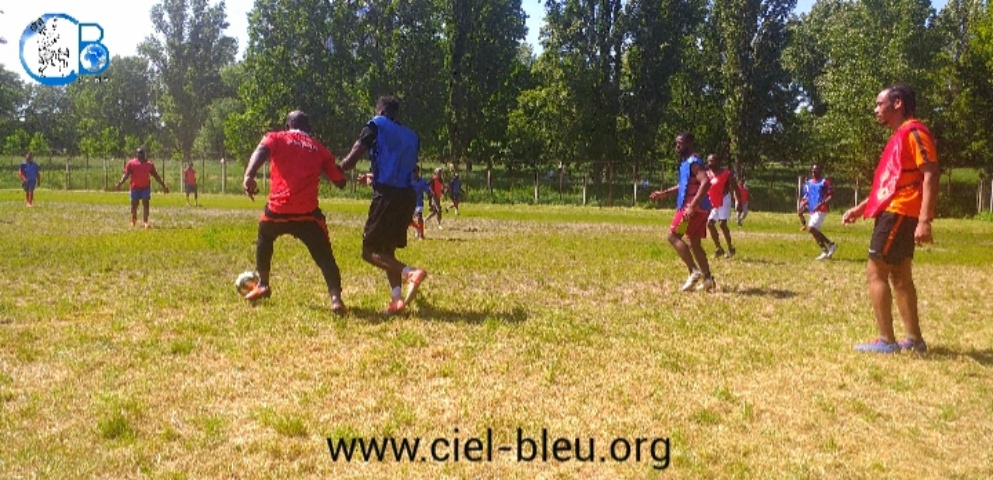
Sunday football gatherings among Cameroonian students and young professionals in Kyiv were far more than sporting events.
They functioned as social meeting points where relationships were formed between newly arrived members and those who had been living in Ukraine for longer periods.
The pitch became a space for exchanging experiences, practical advice, and guidance about everyday life in Ukraine.
Football thus operated as a mechanism of social cohesion.
“Old” and “New”: An Implicit Social Structure
One of the most significant elements of these gatherings was the informal distinction between “old” and “new” members.
These categories do not represent a formal hierarchy but rather different temporal stages of migration.
The “old” embody experience, adaptation, and knowledge of local systems.
The “new” represent entry into an ongoing process of adjustment and orientation.
The football field thus becomes a space where these different migratory temporalities meet.
Expanded Diasporic Sociability
These gatherings were not limited to the Cameroonian community.
Other African participants also took part, extending the social space beyond national boundaries.
A Congolese referee, known as DJ Henry, illustrates these transversal social dynamics within diasporic environments.
The football field becomes a site of African co-presence within a European context.
Between Sport, Everyday Life and Cultural Continuity
Beyond the matches themselves, these encounters extended into informal social moments: shared meals, conversations, and collective gatherings off the pitch.
These hybrid spaces connect cultural practices with everyday life.
Sport functions here as a medium of cultural continuity and social anchoring within an unfamiliar urban environment.
Kyiv as a Space Before Geopolitical Disruption
These social practices are also embedded in a broader geography of African student mobility in Eastern Europe.
Before the profound disruptions brought by war, Kyiv was a space of student circulation, temporary settlement, and transnational educational experience.
The practices described here therefore acquire a retrospective dimension, pointing to social forms that have since been significantly transformed.
Informal Spaces and Cultural Analysis
This case illustrates that cultural dynamics do not only emerge within institutional or visibly mediated spaces.
A large part of social and cultural practice develops in informal contexts that are essential for understanding migration and belonging.
Football here is not only a sport, but a space of social mediation.
Conclusion
The Cameroonian community in Kyiv demonstrates how everyday practices can generate complex social structures within diasporic settings.
Football becomes a site of integration, transmission, and social coexistence.
These informal spaces constitute a key dimension of contemporary cultural dynamics, where relations often precede structures and everyday life becomes an analytical lens for social transformation
—
📝 Article originally published on the historical platform Ciel-Bleu.org and later editorially revised and harmonized for Ciel Bleu Kultur.