
Introduction
International student mobility is not limited to individual academic journeys. It contributes to the formation of transnational spaces where languages, educational systems, cultural experiences, and social adaptation processes intersect.
Before the major geopolitical disruptions caused by war, Kyiv played an important role within these international educational movements. The Ukrainian capital attracted students from Africa, Asia, and other parts of the world, becoming a space of intercultural encounter and transnational learning.
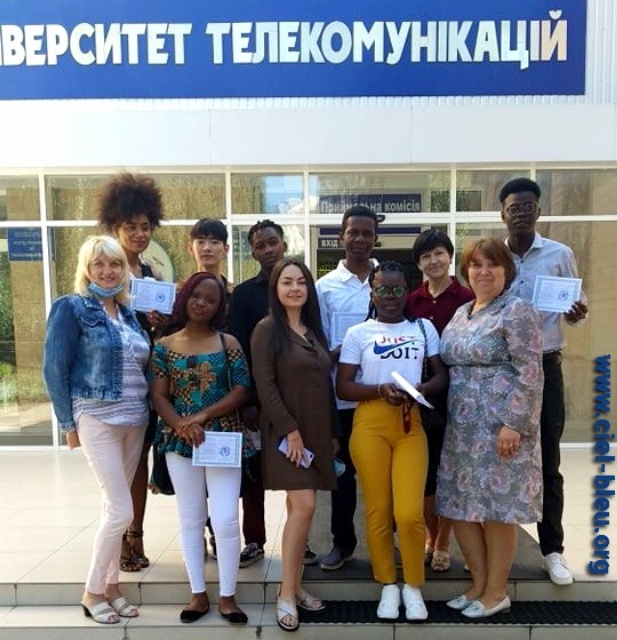
The admission of international students to the State University of Telecommunications in Kyiv illustrates this broader dynamic.
Kyiv as a Space of International Circulation
In 2020, several international students from Africa, Asia, and the Middle East joined the State University of Telecommunications in Kyiv to pursue higher education.
Behind this academic admission lies a broader reality: the growing role of Eastern Europe as an educational destination for international students.
Kyiv emerged as a meeting point between different geographical, social, and cultural trajectories.
The university thus became both a space of knowledge circulation and a site of intercultural interaction.
Language as a Space of Cultural Mediation
One of the central dimensions of these educational pathways is language acquisition.
Before fully entering their academic programs, international students attended Ukrainian language courses designed to facilitate both academic and social integration.
This process extends far beyond the technical learning of a language.
It also represents:
- cultural adaptation,
- social orientation,
- and gradual access to the institutional and social codes of the host country.
Language therefore becomes a space of mediation between different cultural worlds.
Transnational Educational Trajectories
The students come from different national contexts but share a common experience: mobility into a foreign educational environment.
This diversity reflects the emerging global geographies of higher education.
Universities become spaces where:
- personal aspirations,
- professional ambitions,
- mobility strategies,
- and diasporic experiences intersect.
These trajectories progressively generate international networks that extend far beyond the academic sphere itself.
Between Academic Training and Social Adaptation
Integration into a foreign academic environment also requires everyday social adaptation.
Visits to university departments, exchanges with professors, and the discovery of various academic specializations form part of this transition.
Beyond education itself, students must also:
- learn new institutional structures,
- understand different working methods,
- and navigate unfamiliar social environments.
Higher education thus becomes a broader social experience.
The University as an Intercultural Infrastructure
In this context, the university is not simply a place of education.
It also functions as an intercultural infrastructure.
It connects:
- languages,
- knowledge,
- international mobility,
- cultural experiences,
- and different social systems.
These academic environments contribute to the globalization of contemporary educational pathways.
Kyiv Before Geopolitical Disruption
Viewed today, these trajectories acquire a particular historical dimension.
Before the war, Kyiv represented for many international students a relatively stable environment for education, mobility, and professional projection.
Subsequent geopolitical transformations profoundly altered these dynamics and reshaped the conditions of international student mobility.
This article therefore indirectly documents a specific moment in the recent history of transnational education before a major historical rupture.
Conclusion
International student mobility extends far beyond academic training.
It reveals broader dynamics:
- circulation of knowledge,
- linguistic mediation,
- cultural adaptation,
- and transnational networking.
Through the example of Kyiv, we observe how universities create intercultural relationships that exceed the educational sphere itself.
Student mobility thus also becomes an experience of translation between different social and cultural worlds.
—
📝 Article originally published on the historical platform Ciel-Bleu.org, then editorially revised and harmonized for Ciel Bleu Kultur.