

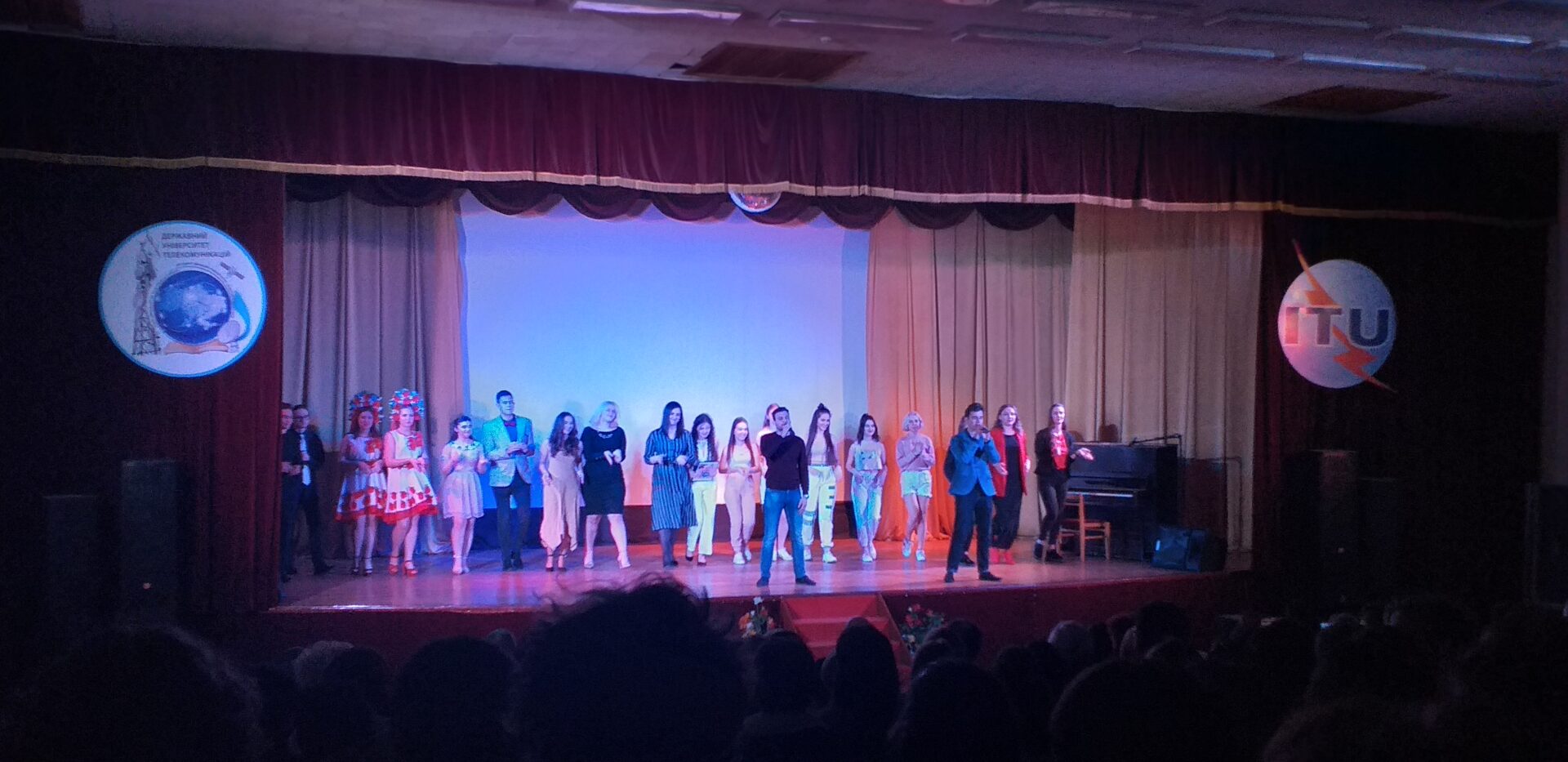
University culture as a frequently underestimated space
In many European and Eastern European universities, student cultural activities are often perceived as peripheral to academic life. This interpretation, however, fails to capture their actual function.
In certain institutional contexts, these activities operate as intermediate spaces: neither fully institutionalized nor purely informal. They produce forms of social and cultural visibility that are rarely explicitly included in official university policies.
In Kyiv, particularly within technical universities, this dynamic becomes visible through internal cultural events that temporarily generate spaces of collective expression among students.
Cultural production without external professionalization
During the International Women’s Day celebration, all artistic performances are produced entirely by students. No external professional cultural actors are involved.
Singing, dancing, and musical performances are organized internally within the student body rather than through a formal cultural department.
Three structural characteristics define this configuration:
- a decentralized internal organization without a central cultural authority
- voluntary participation that remains socially embedded
- permeability across disciplines, cohorts, and backgrounds
This produces a temporary cultural structure that is institutionally enabled but socially generated.
African students and situational visibility
The presence of African students in Ukrainian universities is part of longer-term academic mobility patterns, whose cultural implications are still rarely systematically analyzed at the local level.
This presence is not continuously visible. It emerges in specific situational moments within university life.
Rather than producing continuous representation, these moments generate episodic visibility that shapes social interactions within the institution.
The university thus becomes a space where multiple forms of belonging coexist without being fully integrated into a coherent institutional narrative.
Cultural figures and symbolic condensation
Individual trajectories occasionally serve as reference points for interpreting these cultural circulations.
The case of singer Gaitana, a Ukrainian artist of Congolese origin, illustrates such a configuration.
However, such figures should not be reduced to simple representations. They operate within a tension between:
- individual biography and collective readability
- public visibility and symbolic simplification
- lived social experience and narrative appropriation
They mark not identity itself, but the points where identity becomes publicly legible.
Implicit cultural diplomacy without a central institution
From these observations emerges an analytical hypothesis: cultural diplomacy can exist without explicit institutional design.
These processes are not driven by formal programs but by:
- temporary student-driven scenes
- informal participation structures
- non-formalized social interactions
What matters here is not institutional intention, but the effects produced by these configurations.
Final note
The university events observed in Kyiv do not constitute explicit cultural policy. However, they generate effects of visibility, coexistence, and symbolic narration of social belonging.
These micro-situations point to a subtle layer of international cultural relations located between academic infrastructure and symbolic production.
—
📝 Article originally published on the historical platform Ciel-Bleu.org, then editorially revised and harmonized for Ciel Bleu Kultur.